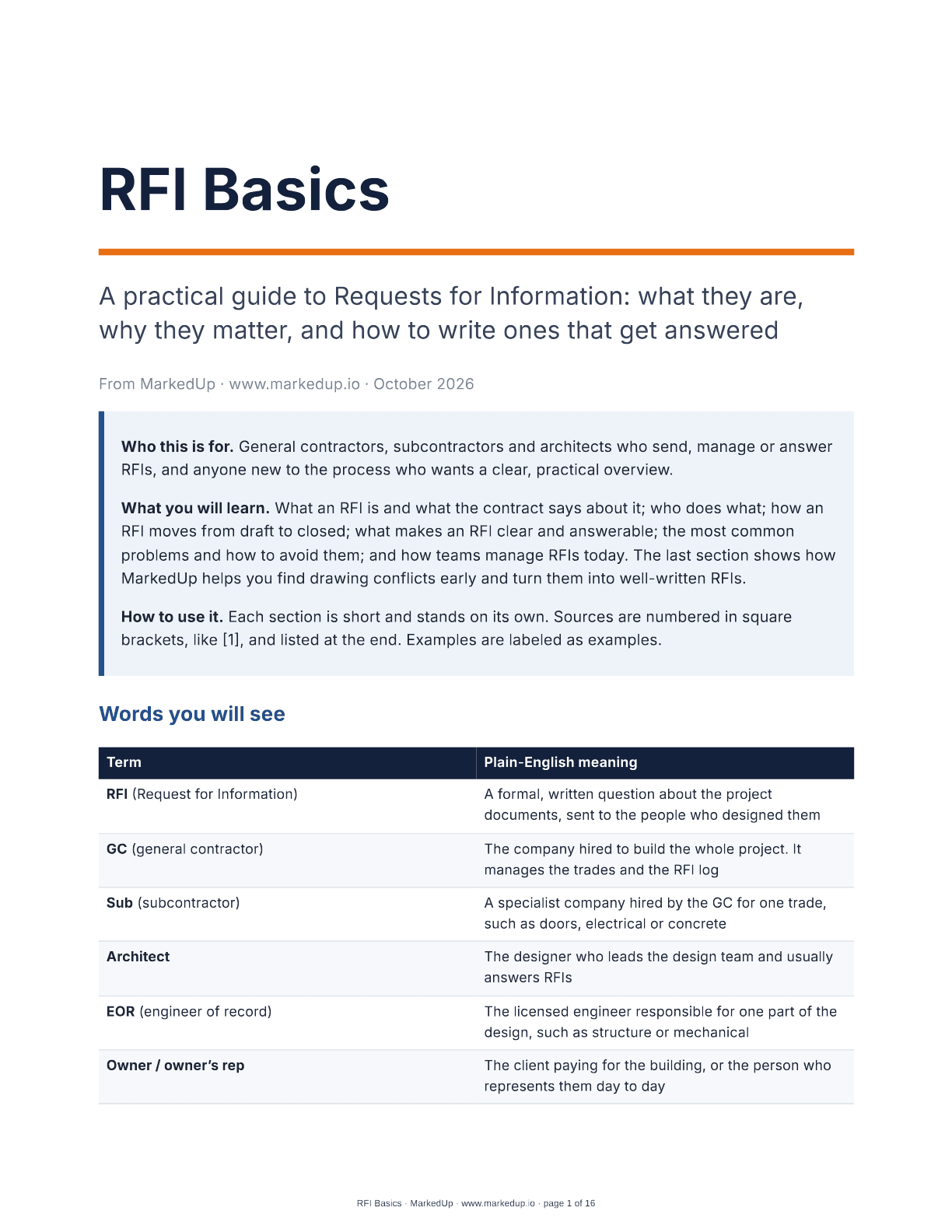
Free 16-page PDF
What is an RFI in construction?
A free 16-page guide on the RFI meaning, what AIA A201 requires, and how to write one that gets a clear answer and helps stop rework and delay claims.
Who it's for: general contractors, subcontractors, architects, and project managers.
PDF, 16 pages. No form.
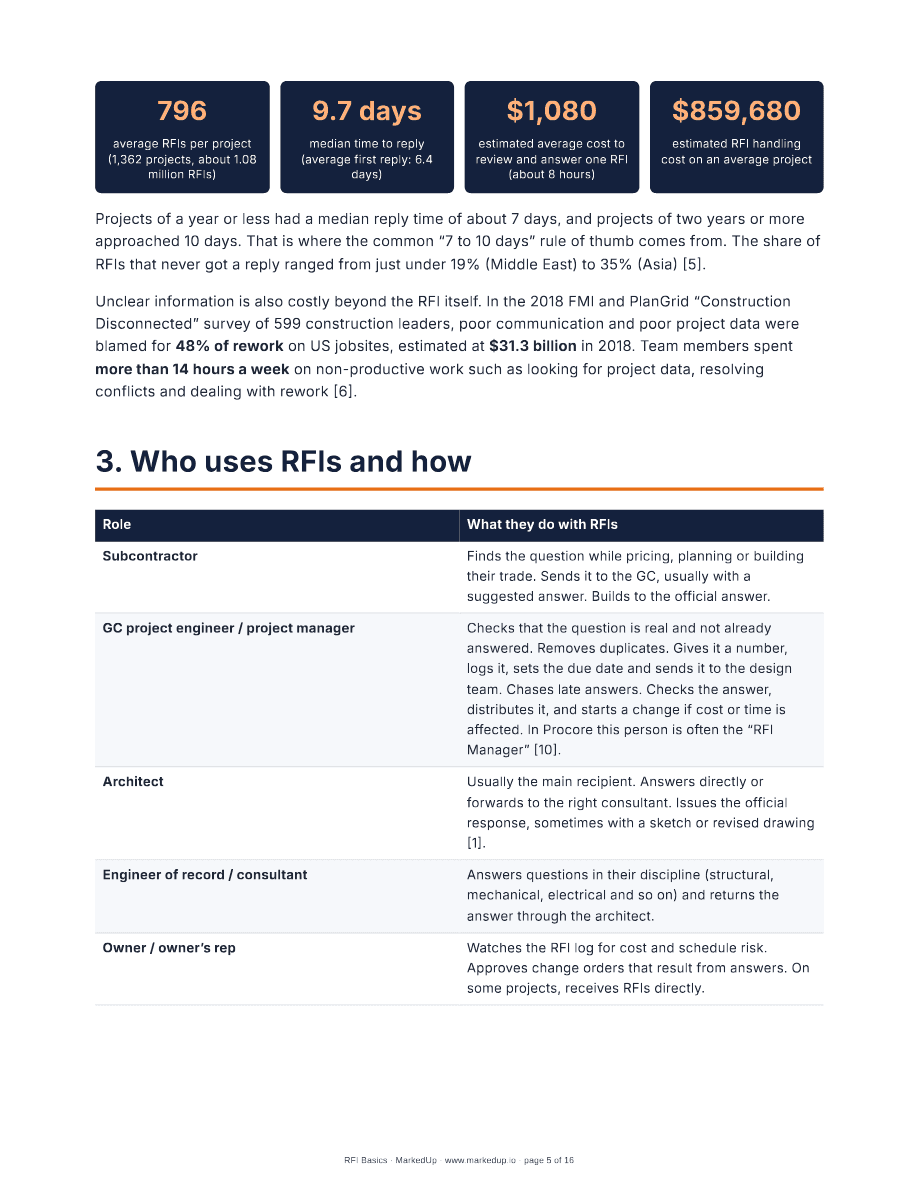
The Navigant Construction Forum's 2013 analysis of Aconex data, hosted by CMAA (the Construction Management Association of America), found 796 average RFIs per project and a $1,080 estimated average cost to review and answer one RFI [5].
What an RFI is
Why it matters
One-Click RFI
What's inside the RFI guide
Sixteen pages you can read in one sitting. Each section stands on its own.
- What an RFI is, and what it is not.
- What AIA A201 requires when the drawings or specifications conflict.
- Who handles an RFI, and how it is routed from the subcontractor to the owner.
- The lifecycle: draft, open, ball in court, answered, and closed.
- What makes a good RFI, shown as a weak example and a strong example.
- Common problems, and when bundling one question across many marks makes sense.
- Where RFIs live: email and a spreadsheet, or Procore, Autodesk Forma Build, and Trimble ProjectSight.
Why RFI volume and cost matter
The largest public study we know of is the Navigant Construction Forum's 2013 analysis of Aconex data, hosted by CMAA (the Construction Management Association of America) [5]:
796 average RFIs per project (1,362 projects, about 1.08 million RFIs)
9.7 days median time to reply (average first reply: 6.4 days)
$1,080 estimated average cost to review and answer one RFI (about 8 hours)
$859,680 estimated RFI handling cost on an average project
Unclear information is also costly beyond the RFI itself. In the 2018 FMI and PlanGrid "Construction Disconnected" survey of 599 construction leaders, poor communication and poor project data were blamed for 48% of rework on US jobsites, estimated at $31.3 billion in 2018 [6].
Get the guide before the next drawing set
The PDF includes the role-by-role table, every lifecycle stage, a component checklist, and the sources.
PDF, 16 pages
Launching October 23, 2026
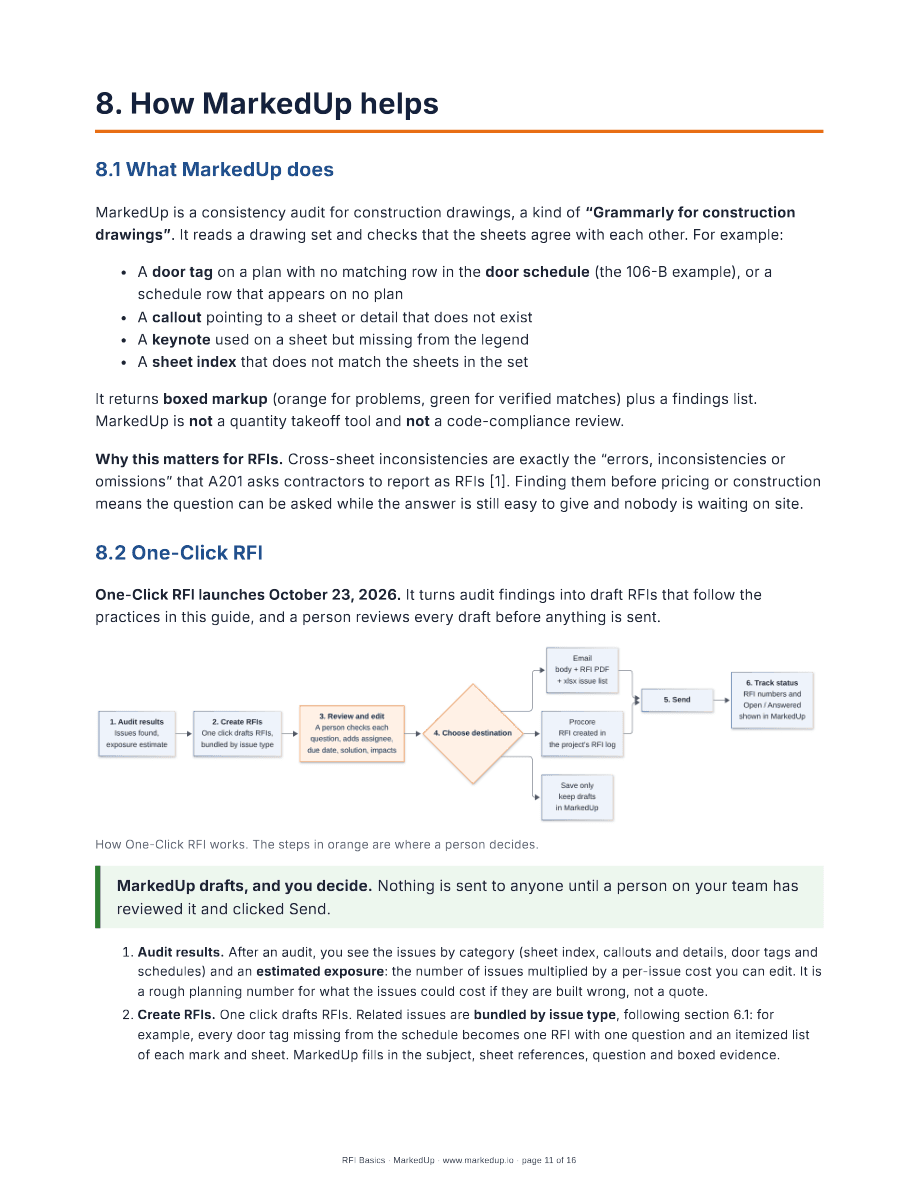
One-Click RFI
One-Click RFI turns drawing-audit findings into bundled RFIs. Related findings become one RFI with one question and an itemized list. A person reviews every draft, then sends it by email or pushes it to Procore. MarkedUp shows each RFI's number and status.
MarkedUp drafts, and a person decides. Nothing is sent until someone has reviewed it and clicked Send.
RFI FAQ
What is an RFI in construction?
In construction, an RFI (request for information) is a formal written question used when drawings or specifications are unclear, incomplete, or contradict each other. The builder asks, the design team answers, and both become part of the project record. An RFI is not a submittal, and it does not itself authorize a change to cost or time.
What does RFI stand for?
RFI stands for request for information. In construction it is a written question about the drawings or specifications. It is not a request for proposal (RFP) or a request for quote, which are procurement documents sent to vendors.
What is the difference between an RFI, a submittal, and a change order?
An RFI asks the design team to clarify the drawings or specifications. A submittal is a shop drawing or product sample sent for approval. A change order changes cost or time. An RFI answer can lead to a change order, but the RFI itself does not authorize that change. AIA A201-2017 says that if the contractor believes an answer adds cost or time, it must raise a formal claim (§3.2.4) [1]. Procore's guide also says an RFI is not a submittal and not a place for general chat [9].
Who writes an RFI?
A subcontractor usually finds the question while pricing, planning, or building, and sends it to the general contractor, often with a suggested answer. The GC project engineer or project manager checks it, numbers and logs it, and sends it to the design team. The architect usually writes the official answer, or forwards the question to the engineer of record.
How long does an RFI response take?
The contract sets the clock. AIA A201-2017 says the architect will respond in writing "within any time limits agreed upon or otherwise with reasonable promptness" (§4.2.14) [1]. The Navigant Construction Forum's 2013 analysis found a 9.7 days median time to reply (average first reply: 6.4 days) [5]. Some owners set their own number. A California Judicial Council contract, for example, requires a response within 14 days [4].
What goes in an RFI log?
An RFI log is the running list of every RFI on the project. Keep the same parts a good RFI already has: the RFI number, the project, the subject, who sent it, who must answer, the date sent, the due date, the drawing and spec references, the question, any stated cost or schedule impact, the status (including who must act next), and the official response with the date it came back [3][8][13].
What is a simple RFI example?
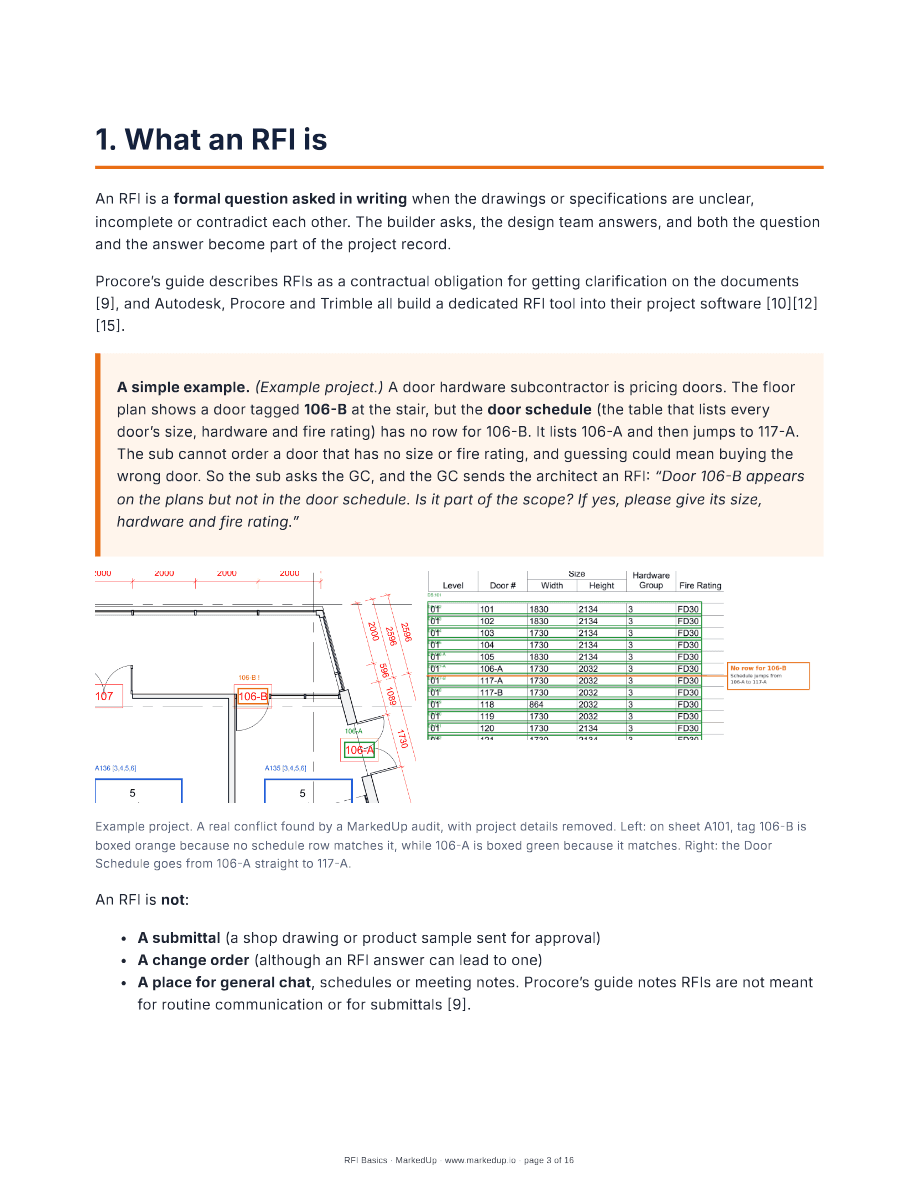
Door tag 106-B appears on sheets A101 and A135, but the door schedule on A101 has no row for 106-B. It lists 106-A, then 117-A. A clear RFI asks whether 106-B is in scope and, if it is, asks for the width, height, hardware group, and fire rating. It cites the sheet numbers and includes a marked-up crop of the plan and the schedule.
How do you write an RFI?
State one question. Include the RFI number, the project, a clear subject, who it is from and to, the date sent and the due date, the drawing and spec references, a marked-up picture of the conflict, a proposed solution, and any cost or schedule impact. Procore, Autodesk, and the ConsensusDocs forms list nearly the same parts [3][8][13].
What does AIA A201 say about an RFI?
AIA A201-2017 says the contractor must promptly report errors, inconsistencies, or omissions to the architect "as a request for information in such form as the Architect may require" (§3.2.2). The architect responds in writing within any time limits agreed upon, or otherwise with reasonable promptness (§4.2.14). If the contractor believes an answer adds cost or time, it must raise a formal claim (§3.2.4) [1].
The full article
A Request for Information, or RFI, is the formal way a construction team asks the design team a question about the drawings or specifications. This guide explains what an RFI is, why the contract requires it, who handles it, and how to write one that gets a clear, useful answer. It is written for anyone who needs to understand RFIs without being a construction engineer: sales and customer success teams, new hires, and project teams who want a refresher.
Want the full guide as a PDF, with the role-by-role table, every lifecycle stage, a component checklist and all 16 sources? Get the free RFI guide (PDF, 16 pages).
What is an RFI in construction?
An RFI is a formal question asked in writing when the drawings or specifications are unclear, incomplete, or contradict each other. The builder asks, the design team answers, and both the question and the answer become part of the project record. Procore's guide describes RFIs as a contractual obligation for getting clarification on the documents [9], and Autodesk, Procore and Trimble all build a dedicated RFI tool into their project software [10][12][15].
RFI means request for information. In construction, that question is about the contract documents for this job. It is not a request for proposal (RFP) or a request for quote sent to vendors [9].
A worked version of a real conflict is in a simple RFI example below.
A simple RFI example
A door hardware subcontractor is pricing doors. The floor plan shows a door tagged 106-B at the stair, but the door schedule (the table that lists every door's size, hardware and fire rating) has no row for 106-B. It lists 106-A and then jumps to 117-A. The sub cannot order a door that has no size or fire rating, so the general contractor (GC) sends the architect an RFI.
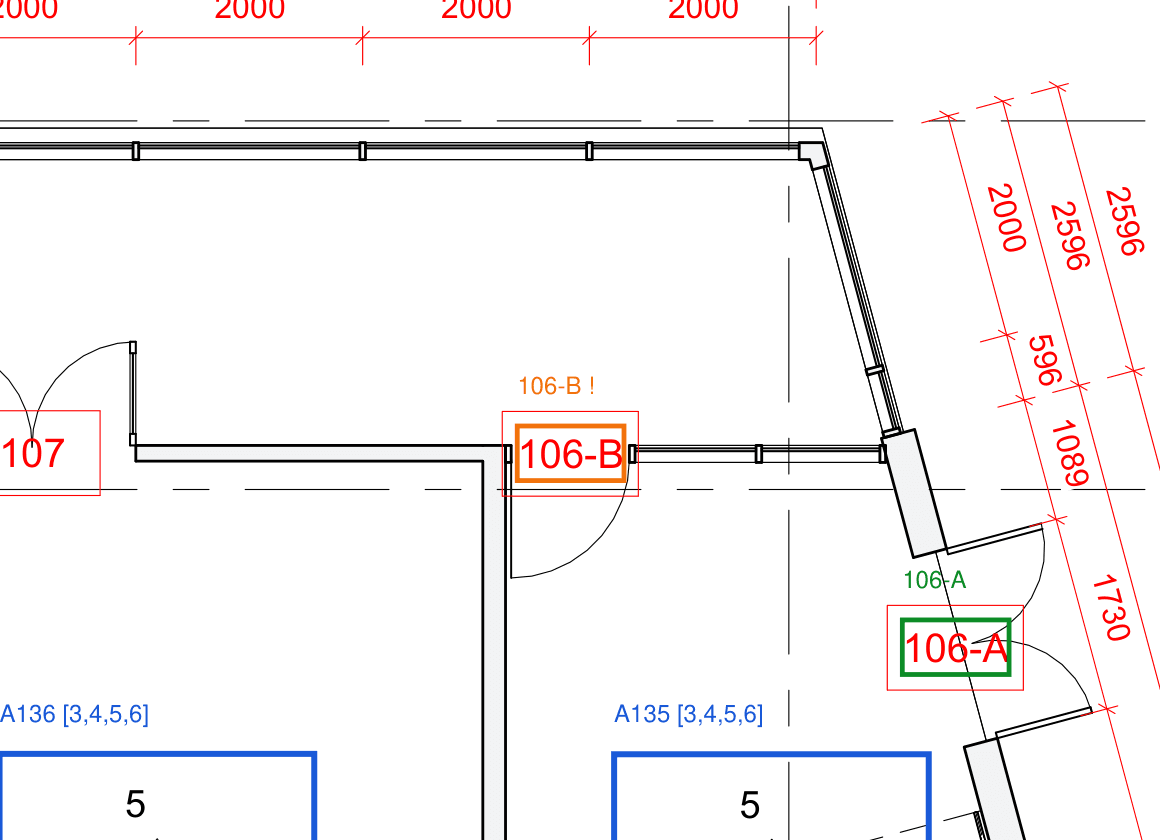
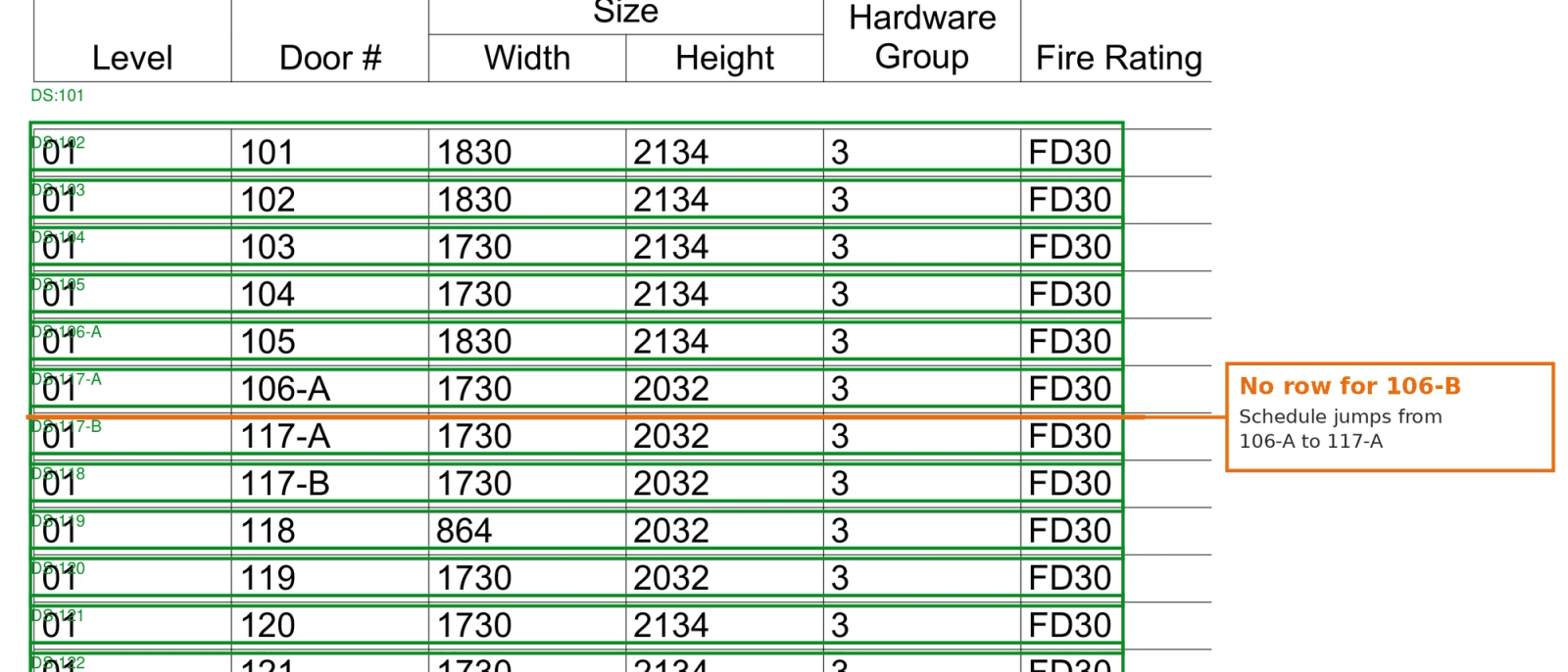
Example. The conflict above comes from a MarkedUp audit of a sample drawing set. Tag 106-B is boxed orange because no schedule row matches it. The door schedule goes from 106-A straight to 117-A.
Here is the same problem written two ways.
Weak RFI. Subject: "Doors." Question: "The door schedule seems incomplete. Please advise on all doors." No references, no evidence, no impacts. The reviewer has to search the whole drawing set to work out what "incomplete" means, so the answer is likely to be "please clarify," which costs a week.
Strong RFI. Subject: "RFI-014 | Door 106-B missing from door schedule (A101 / A135)." Question: "Door tag 106-B appears on A101 and A135, but the Door Schedule on A101 has no row for 106-B. It lists 106-A, then 117-A. Is 106-B in scope? If yes, please give width, height, hardware group and fire rating. If no, please confirm the tag should be removed." It includes boxed crops of the plan tag and the schedule, a proposed solution to confirm or revise, and stated impacts.
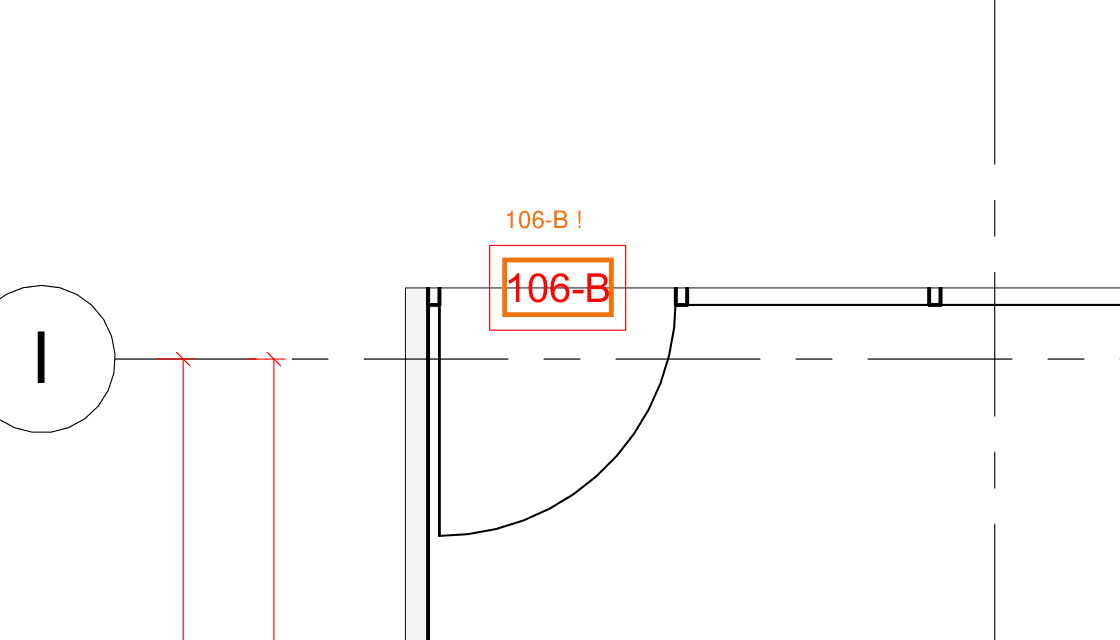
Example. Names in these examples are placeholders.
RFI vs submittal vs change order
These three documents show up on the same job, sometimes about the same door or detail. They do different work.
- RFI. A formal written question when the drawings or specifications are unclear, incomplete, or contradict each other. The design team answers in writing, and both the question and the answer stay in the project record. An RFI is not a place for general chat or meeting notes [9].
- Submittal. A shop drawing or product sample the contractor sends for approval before that product is ordered or installed [9]. A submittal asks whether this product matches the spec. An RFI asks what the spec means.
- Change order. A formal change to cost or time. An RFI answer can lead to one, but the RFI itself does not authorize it. Under AIA A201-2017, if the contractor believes an answer adds cost or time, it must raise a formal claim (§3.2.4) [1]. The owner or owner's rep approves change orders that result from answers.
If the documents conflict, send an RFI. If you need a product approved, send a submittal. If the price or the schedule has to change, that is a change order.
What AIA A201 says about an RFI
Most construction contracts make the RFI the official way to raise a problem in the documents. The most widely used US general conditions, AIA A201-2017, say [1]:
- The contractor must study and compare the contract documents and "promptly report to the Architect any errors, inconsistencies or omissions" it finds, "as a request for information in such form as the Architect may require" (§3.2.2).
- The architect "will review and respond to requests for information about the Contract Documents," in writing, "within any time limits agreed upon or otherwise with reasonable promptness" (§4.2.14).
- If the contractor believes an answer adds cost or time, it must raise a formal claim (§3.2.4). If it fails to report a problem it found, it may have to pay for costs that could have been avoided.
ConsensusDocs, the other major family of standard contracts, publishes standard RFI forms (ConsensusDocs 204 and 790) with space for the issue, the clarification needed, the potential cost or schedule impact, and the response [2][3]. Owners often add their own rules. For example, a California Judicial Council contract requires each RFI to set out "the single issue" with spec section and drawing references, and to receive a response within 14 days [4].
How many RFIs, and what they cost
The largest public study we know of is the Navigant Construction Forum's 2013 analysis of Aconex data, hosted by CMAA (the Construction Management Association of America) [5]:
- 796 average RFIs per project (1,362 projects, about 1.08 million RFIs)
- 9.7 days median time to reply (average first reply: 6.4 days)
- $1,080 estimated average cost to review and answer one RFI (about 8 hours)
- $859,680 estimated RFI handling cost on an average project
Unclear information is also costly beyond the RFI itself. In the 2018 FMI and PlanGrid "Construction Disconnected" survey of 599 construction leaders, poor communication and poor project data were blamed for 48% of rework on US jobsites, estimated at $31.3 billion in 2018 [6].
RFI response time
The contract sets the RFI response time. AIA A201-2017 does not name a number of days. It says the architect will respond in writing "within any time limits agreed upon or otherwise with reasonable promptness" (§4.2.14) [1]. Some owners write a number into the general conditions. A California Judicial Council contract requires a response within 14 days [4].
Across the projects in Navigant's 2013 study, the median time to reply was 9.7 days, and the average first reply was 6.4 days [5]. The same study found that 19% to 35% of RFIs never got a reply, depending on region [5].
Put a due date on the RFI, name the ball in court, and chase it before the date passes. The response time is not the same on every job. It is whatever that contract says, tracked in the RFI log.
Who handles an RFI
- Subcontractor: finds the question while pricing, planning or building, and sends it to the GC, usually with a suggested answer.
- GC project engineer or project manager: checks the question is real, removes duplicates, numbers and logs it, sets the due date, sends it to the design team and chases late answers.
- Architect: usually the main recipient. Answers directly or forwards to the right consultant, and issues the official response [1].
- Engineer of record or consultant: answers questions in their discipline and returns the answer through the architect.
- Owner or owner's rep: watches the RFI log for cost and schedule risk and approves change orders that result from answers.

The RFI process
Every RFI moves through the same basic stages, even if each software tool names them a little differently: Draft (being written), Open (sent, numbered and given a due date), Ball in court (shows who must act next), Answered (the GC checks the answer is clear) and Closed (the answer is shared, and any cost or time change starts a change process). Autodesk Forma Build, for example, uses Draft, Submitted, Open, Answered and Closed [11].

Before an RFI is numbered, someone on the GC team should check that the answer is not already in the drawings, an addendum, or an earlier RFI. A question that is already answered does not need a new number.
How to write an RFI
RFI template: what to include
Procore, Autodesk and the ConsensusDocs forms list nearly the same building blocks [3][8][13]: an RFI number, the project, a clear subject, who it is from and to, the date sent and due date, drawing and spec references, one clear question, marked-up visual evidence showing both sides of the conflict, a proposed solution, the cost and schedule impact, and the status and official response.
The door 106-B example above uses those parts. The weak version leaves them out.
One issue per RFI, and when bundling makes sense
"One issue" means one question, not one location. When an audit finds the same type of problem in many places, such as 7 door tags missing from the schedule, appearing 17 times across 8 sheets, you can send one RFI with one question and an itemized list of every mark, sheet and location. At Navigant's estimate of about $1,080 to process each RFI [5], that can save real review effort. Bundle only when every item shares the same question and the same person can answer all of it, list every item, and check the project's RFI rules first.
Common RFI problems and how to avoid them
- Vague questions such as "please advise." Say exactly what conflicts with what, and what answer you need. Autodesk notes that poorly defined problems, or too many issues in one RFI, lead to inaccurate answers [7].
- Missing references. Always give the sheet number, location and revision, plus a marked-up picture.
- Several unrelated issues in one RFI. Different issues have different answerers and deadlines, so keep one question per RFI.
- RFIs used to shift risk. Navigant describes contractors using RFIs to build a paper trail for later claims, and a cited study found about 13.2% of RFIs were "not justifiable" [5]. Check the documents first.
- Slow responses. Set realistic due dates, track ball in court and escalate early. Navigant's data shows 19% to 35% of RFIs never got a reply, depending on region [5].
What goes in an RFI log
An RFI log is the running list of every RFI on the job. Smaller projects often keep it in a spreadsheet next to the email thread. Larger GCs keep the same fields on each record in a project management system such as Procore [10].
Use the building blocks of the RFI itself as the columns [3][8][13]:
- RFI number and project
- Subject
- Who it is from, and who must answer
- Date sent and due date
- Drawing and spec references
- The question, as one clear sentence
- A proposed solution, if the sender offered one
- Cost and schedule impact, if the sender stated one
- Status, including ball in court (who must act next)
- The official response, and the date it came back
Attach the marked-up evidence to the row rather than describing the conflict from memory. Close the row when the answer has been shared. If that answer changes cost or time, the next step is a change process, not another line in the log. The owner or owner's rep watches the log for that cost and schedule risk.
Where RFIs live: email or a project management system
Many projects, especially smaller ones, still run RFIs as a Word or PDF form sent by email and tracked in an Excel log. Everyone has email, but the log is updated by hand and answers get buried in reply chains. Larger GCs usually manage RFIs in a project management system such as Procore, Autodesk Forma Build or Trimble ProjectSight, where each RFI is one record with its question, references, ball in court, due date, history and official answer [10][11][15]. Whatever the tool, the building blocks of a good RFI are the same.

How MarkedUp helps teams send better RFIs, earlier
MarkedUp is Grammarly for construction drawings. It reads a drawing set and checks that the sheets agree with each other: door tags and schedules, callouts that point to sheets or details that do not exist, keynotes missing from the legend, and a sheet index that does not match the set. It returns boxed markup (orange for problems, green for verified matches) plus a findings list. MarkedUp does not do quantity takeoff and does not check code compliance.
Those cross-sheet conflicts are exactly the "errors, inconsistencies or omissions" that A201 asks contractors to report as RFIs [1]. Finding them during an audit, before pricing or construction, moves the RFI earlier, when an answer is cheap and nobody is waiting on site.
One-Click RFI, launching October 23, 2026
One-Click RFI turns audit findings into draft RFIs. Related findings are bundled by issue type into one RFI with one question and an itemized list, with sheet references and boxed evidence already filled in. A person reviews every draft, adds the assignee, due date, proposed solution and impacts, and then chooses where it goes: by email with the RFI PDF and an xlsx issue list attached, or into Procore. MarkedUp drafts, and a person decides. Nothing is sent until someone has reviewed it and clicked Send.
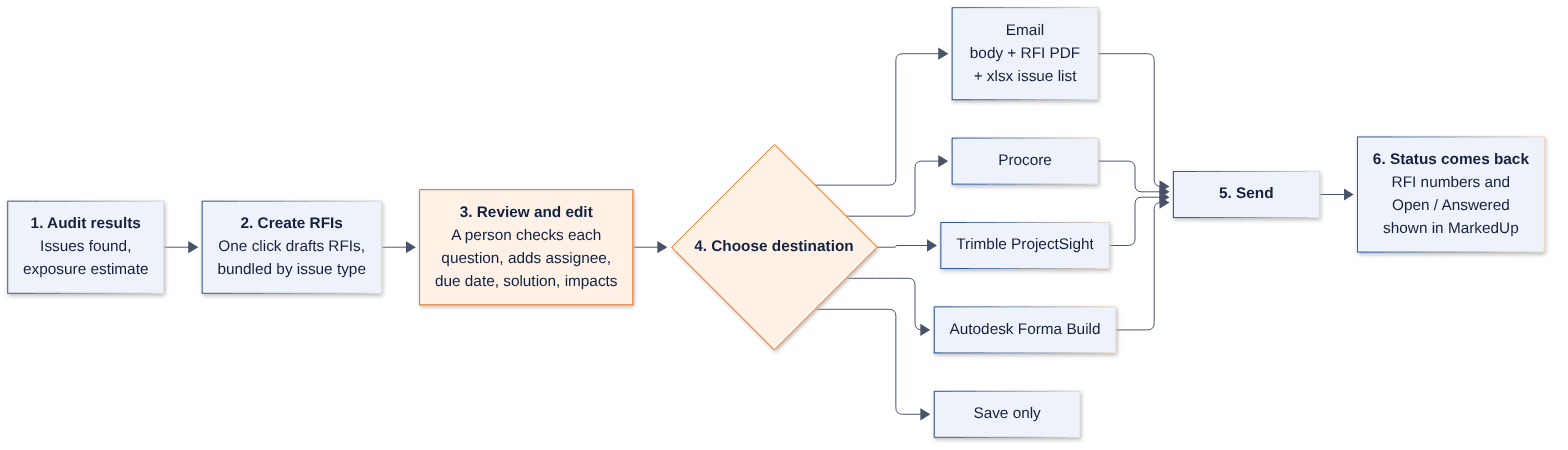
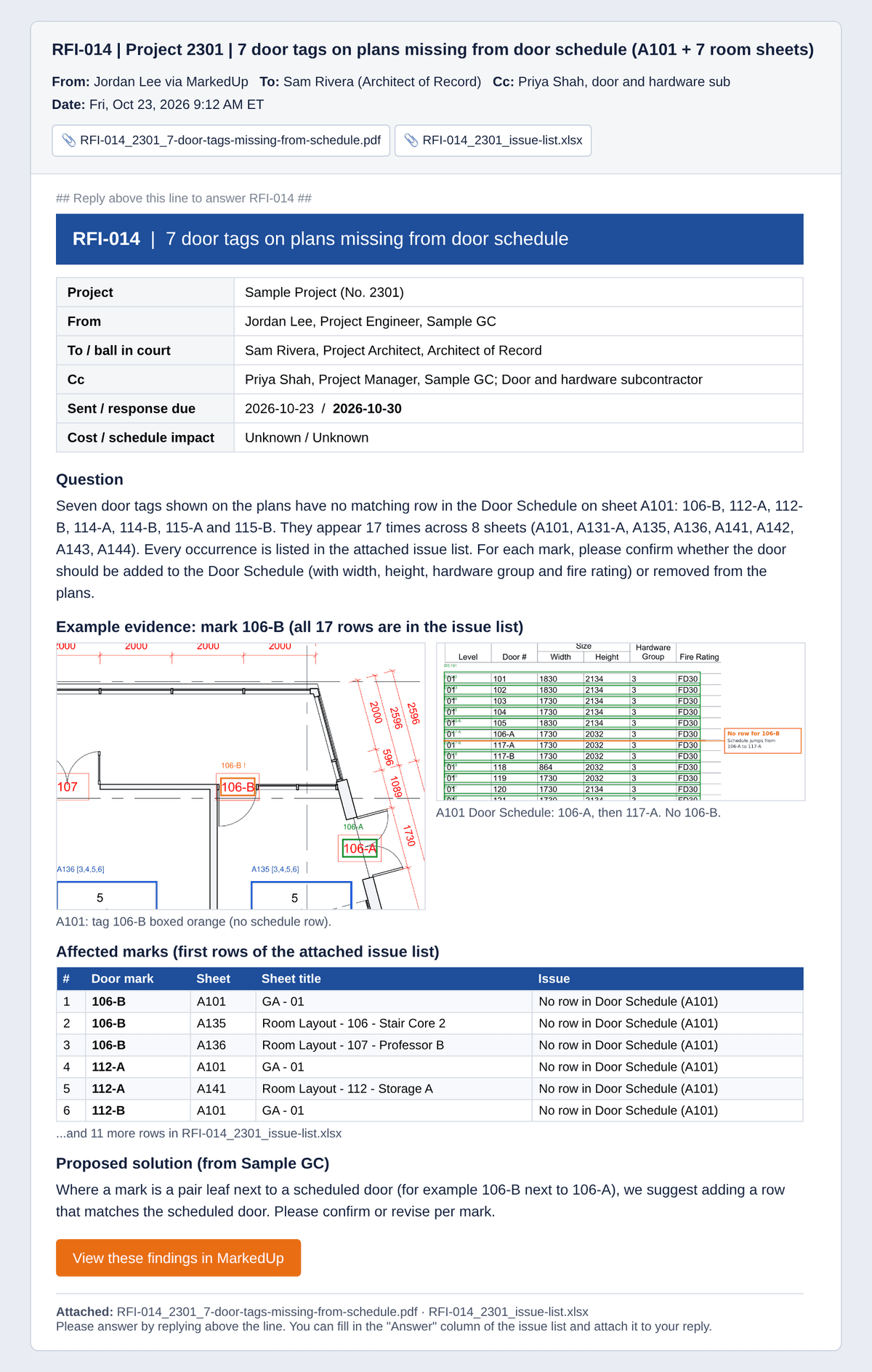
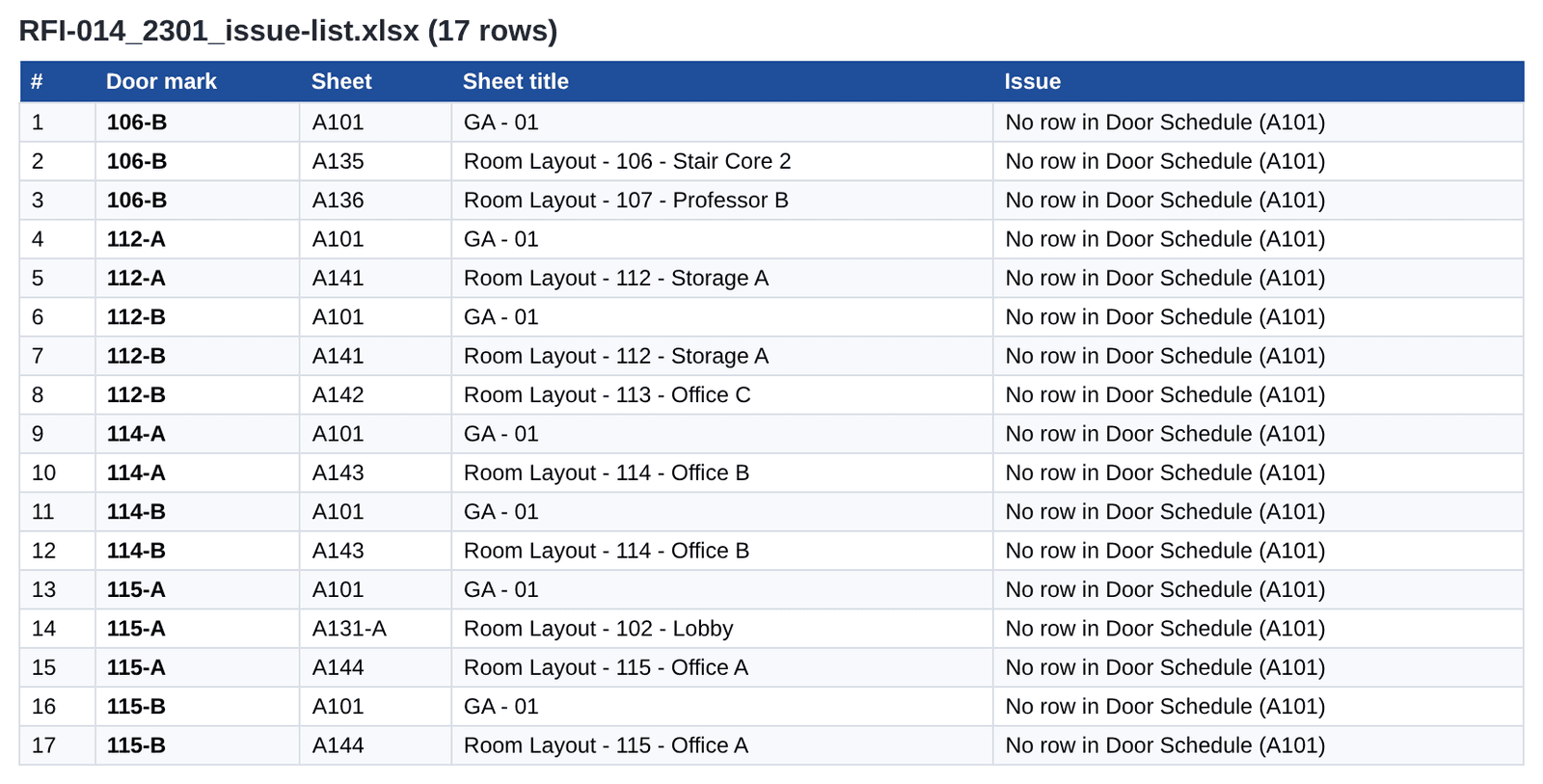
Example bundled RFI from a sample drawing set. Names and project number are placeholders.
MarkedUp also connects to the tools teams already use, including Bluebeam Session, Autodesk Forma, Trimble Connect, Google Drive and Microsoft SharePoint, with notifications in Slack and Microsoft Teams. See all integrations.
See it on your own drawings
Want to see which RFIs are hiding in your current drawing set? Book a meeting and we will walk through an audit with you. Teams can start with a 90-day pilot at $1,500 per office. For more reading, see the MarkedUp blog and the lessons in Blueprint Academy.
Sources
Numbering matches the full RFI Basics guide.
- 1. American Institute of Architects, AIA Document A201-2017, General Conditions of the Contract for Construction, §§3.2.2, 3.2.4 and 4.2.14. https://assets.aiacontracts.com/ctrzdweb02/zdpdfs/aia-a201-2017-comparative-a101-exhibit-new.pdf
- 2. ConsensusDocs, 204 Request for Information. https://www.consensusdocs.org/contract/204-request-for-information/
- 3. ConsensusDocs, 790 Standard Request for Information (RFI) and Response Form. https://www.consensusdocs.org/contract/790-standard-request-for-information-rfi/
- 4. Judicial Council of California, Administrative Office of the Courts, General Conditions of the Contract for Construction, RFI provisions. https://courts.ca.gov/system/files/solicitation-request-document/mamlakes-rfp-atth.pdf
- 5. Navigant Construction Forum, Impact & Control of RFIs on Construction Projects, April 2013, hosted by CMAA. https://www.cmaanet.org/sites/default/files/2018-04/NCF%20IMPACT%20%26%20CONTROL%20OF%20RFIs%20ON%20CONSTRUCTION%20PROJECTS.pdf
- 6. PlanGrid and FMI, "Construction Disconnected" survey results, press release, August 1, 2018. https://www.prnewswire.com/news-releases/new-research-from-plangrid-and-fmi-identifies-factors-costing-the-construction-industry-more-than-177-billion-annually-300689826.html
- 7. Autodesk, Construction RFI Meaning and Template. https://www.autodesk.com/blogs/construction/construction-rfi-template/
- 8. Autodesk, RFI templates for construction. https://construction.autodesk.com/resources/checklists/rfi-template/
- 9. Procore, RFIs: A Contractor's Guide to Requests for Information. https://www.procore.com/library/rfi-construction
- 10. Procore Support, What is the RFI Manager role? https://en-ca.support.procore.com/faq/what-is-the-rfi-manager-role
- 11. Autodesk Forma Build Help, Process RFI. https://help.autodesk.com/cloudhelp/ENU/Build-Rfis/files/work-rfis/Process_RFI.html
- 12. Autodesk Forma Build Help, RFIs Overview. https://help.autodesk.com/view/BUILD/ENU/?guid=RFIs_Overview
- 13. Procore, RFI Templates for Construction. https://www.procore.com/library/rfi-templates
- 15. Trimble Help, Requests for information (RFIs), ProjectSight. https://help.trimble.com/doc/projectsight/projectsight/go/records/requests-for-information-rfis
See it on your drawings
Want to see which RFIs are hiding in your current drawing set? Book a meeting and we will walk through an audit with you. Teams can start with a 90-day pilot at $1,500 per office.
PDF, 16 pages